

Parkinson’s & Aquatic Therapy: Causes, Care & Exercises
Parkinson’s disease is a progressive neurodegenerative disorder of the central nervous system (CNS) affecting mobility. It is caused by the loss of dopamine-producing cells in a region of the brain known as the substantia nigra, leading to motor and non-motor symptoms.
Parkinson’s disease was identified by James Parkinson in the year 1817. It took around 100 years to fully understand the pathophysiology of the disease, and only partial success was attained in its treatment through the use of Levodopa in the year 1960.
In this blog, we will explore the causes of Parkinson’s, its symptoms, and complications, along with how aquatic therapy and targeted exercises can support better balance, mobility, and overall movement.
What Causes Parkinson’s Disease? Understanding the Aetiology
- Idiopathic: In this case, degeneration of neurons in the substantia nigra and corpus striatum (striatonigral pathway) occurs. This disease affects older adults, particularly those in late adulthood, and develops gradually, eventually being fatal within 10-15 years from the time of disease diagnosis. In this scenario, the causative agent is unknown.
- Vascular: Multi-infarct disease (atherosclerotic parkinsonism).
- Infection: Infection by various viruses, most commonly the influenza virus, may be causing parkinsonism-like features. It is termed ‘encephalitis lethargica’, which causes localised damage to the brain tissue.
- Due to Toxicity: Certain toxic chemicals like manganese, carbon disulphide, carbon monoxide, and cyanide exposed in various occupations can cause diffuse damage to the brain, exhibiting parkinsonian syndromes.
- Various Drugs: Phenothiazines, butyrophenones, and tetrabenazine are a few of the drugs that can cause Parkinson’s.
- Multiple System Degeneration: Occurs in conditions like Alzheimer’s disease, Shy-Drager syndrome, supranuclear ophthalmoplegia, Wilson’s disease, etc.
- Metabolic: Abnormal calcium metabolism can cause deposition of calcium in the basal ganglia, causing Parkinson’s.
- Traumatic: Repeated brain trauma, commonly seen in boxers, may lead to parkinsonism; this presentation is often referred to as punch‑drunk syndrome.
Start Personalised Aquatic Therapy for Parkinson’s Recovery
How Does Parkinson’s Disease Affect the Brain? Understanding Pathology
Degeneration of neurons in the striatonigral pathway leads to deficiency in the level of dopamine, a vital neurotrasmitter. This deficiency inhibits the excitation of the cholinergic pathway, which has acetylcholine as the neurotransmitter.
Thus, a decrease in the dopamine level removes the inhibitory influence on the cholinergic pathway, causing excessive excitation of the extrapyramidal system (reticulo and rubro), which causes increased tone in the agonist and antagonist. This gives rise to rigidity and bradykinesia. However, what exactly causes the tremors is still not confirmed.
What Are the Common Clinical Features of Parkinson’s Disease?
A. Motor Symptoms
1. Disturbances in Voluntary Movement
Although there is no involvement of the corticospinal tract, the patient still exhibits difficulty in the performance of voluntary movement, mainly due to two abnormal features.
- Bradykinesia
According to Jacksonian’s principle, this is a negative feature of parkinsonism. It means slowing of movement with a decrease in the amplitude and intensity of contraction. There is plenty of time lag between a patient’s desire to act and the actual action produced. This is called increased reaction time. There is also an increase in movement time, which is the total time needed by the patient to complete a single sequence of movement. These disabilities are more pronounced while performing precision functions involving distal parts of the body. The exact mechanism is not known, but it is theoretically presumed that it could be because of the difficulty of the basal ganglia in integrating sensory information. EMG (electromyography) studies have proved that there is a lot of time lapse before actual recruitment of motor units and firing by motor units which contributes to bradykinesia (slowness) and muscle fatigue.
- Rigidity
This can be called a positive feature in parkinsonism. It is manifested as cocontraction of agonist and antagonist muscles due to an increase in the supraspinal influences on the normal spinal system, causing increased tone in the agonist and the antagonist. The patient usually complains of rigidity as a sensation of heaviness or stiffness in the limbs. Rigidity may involve all the body parts and may be symmetrically or asymmetrically distributed.
It occurs in three forms:
- Lead pipe: In this, the resistance is constant and uniform.
- Cogwheel: In this, the resistance is intermittent but uniform.
- Akinesia: It is an inability to initiate movement. It occurs due to severe rigidity.
2. Postural Disturbances
The patient’s ability to maintain both static and dynamic posture or balance is severely impaired due to the combined influence of disturbances in vestibular, proprioception, visual, and righting reactions. There is also loss of protective reaction of upper limb extension during a fall, causing fear of injury to the patient.
Because of these balance challenges, hydrotherapy for Parkinson’s patients is often recommended, as it provides a safe environment for postural and gait training.
3. Tremors
This is defined as involuntary oscillations of body parts at frequencies ranging from 3.5 to 7 Hz. It is one of the cardinal signs of parkinsonism, and in many patients this is the first sign of disease. The tremors occur due to uninhibited activity of the basal ganglia-cortico-thalamus circuit as a result of degeneration of the striatonigral pathway. The tremors seen in parkinsonism are resting tremors which are absent in sleep and increase with voluntary efforts or emotional excitement. The tremor is typically the pill-rolling type observed in the finger. Tremors may also occasionally be seen in the lips and tongue.
4. Gait Disturbances
Combinations of movement and sequential movement tasks are grossly affected in Parkinson’s. Initially, there is only a lack of associated movements, like swinging of the arm while walking. Later, the gait becomes slow and shuffling with small steps. The initiation of walking is difficult, but after initiation the patient may walk fast with small steps in a bent attitude and eventually run as if to catch up to their centre of gravity. This is called ‘festinating gait’. On the other hand, patients may also have freezing of gait. Some patients may have difficulty stopping suddenly and need external force to stop.
B. Physical Manifestations (appearance & speech)
- Facial Attitude
Parkinson’s patients suffer from a masked or expressionless face. The person appears to be continuously staring. There is constant frowning in the majority of individuals. The skin appears shiny and greasy with increased salivation and drooling due to autonomic dysfunction.
- Posture
Stooped attitude with flexed trunk and limbs.
- Speech
Parkinsonism patients have slurred speech. Handwriting is micrographia (the size of the letters gradually becomes smaller and smaller).
- Dysphagia
It may be seen in about 50 per cent of patients with parkinsonism. As the condition progresses, symptoms such as swallowing difficulties and speech changes may benefit from specialised multidisciplinary care at the best neurorehabilitation centre in Mumbai.
- Visual Difficulties
-
- Blurring of vision
- Decreased blinking causing eye strain
- Rarely diplopia
- Glabellar tap reflex fails to habituate
- Oculogyric crisis may occur
C. Functional and Neurological Changes
- Asthenia
Generalised weakness may be seen, although these are not due to direct involvement of lower motor neurons but mainly due to deconditioning and rigidity.
- Reflexes
Deep tendon reflexes are not directly affected but may be difficult to elicit or reduced in amplitude due to rigidity. Plantar response is going down.
- Sensory Involvement
Inactivity and stiffness may cause generalised body pain in 50 per cent of cases along with cramps and tight muscles.
D. Cognitive and Psychological Impairment
Dementia is very common in about 40 per cent of parkinsonism patients. Other manifestations include:
- Depression
- Lack of motivation
- Over-dependency
- Difficulty in vertical perception
- Body scheme disorder
- Body image disorder
- Topographical disorientation
To efficiently manage these symptoms effectively, exercises for Parkinson’s into a structured rehabilitation programme are suggested. This aids in improving movement control and functional independence.
What Complications Can Develop in Parkinson’s Disease?
- Joint Tightness and Contractures: Decrease in joint range and flexibility causing tightness and contracture. Contractures are seen in hip and knee flexors, hip adductors, trunk flexors, neck flexors, shoulder adductors, elbow flexors, and wrist and finger flexors. Kyphotic deformity is common due to the patient’s abnormal posture.
- Muscle Atrophy and Weakness: These are secondary dysfunctions resulting from prolonged inactivity and reduced functional movement.
- Cardiopulmonary Changes: Deconditioning of the cardiovascular and respiratory system is common due to decreased activity and kyphotic posture that causes compression of the vital structures in the thorax.
- Osteoporosis: Prolonged inactivity and poor diet common in Parkinson’s may lead to weakening of the bones (osteoporosis). This increases the chances of bone fractures due to falls.
- Oedema: This may occur in the distal parts of the foot due to venous pooling as a result of decreased pumping action of the calf muscles.
- Skin Infections: Inflamed skin (dermatitis) may occur due to increased secretions from the sweat and sebaceous glands.
Aquatherapy For Parkinson’s Disease
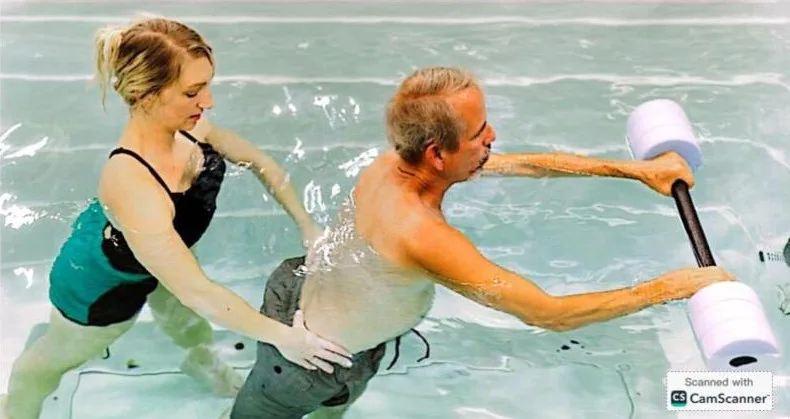
Water Walking
- Walk forward, backward, and sideways in chest-deep water
- Focus on long strides and arm swings
- Helps improve gait and balance (often affected by Parkinson’s)
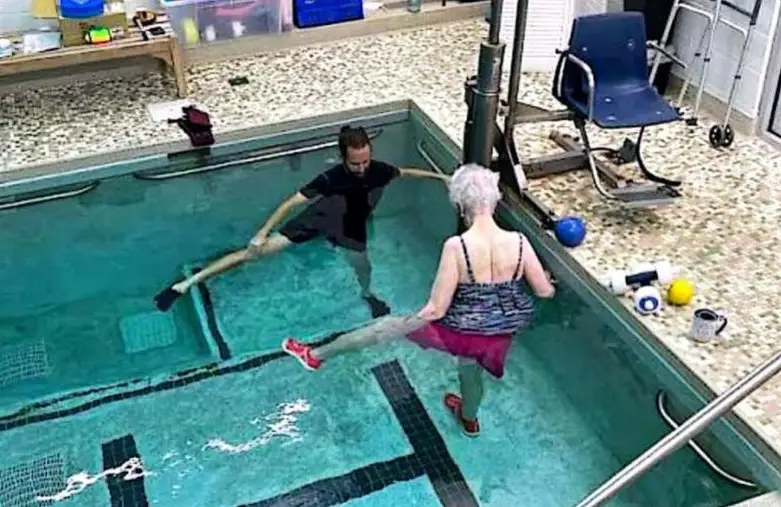
Leg Lifts & Marching
- Grab the edge of the pool or hold on to a buoy
- Lift knees high (marching) or extend legs forward/backward
- Strengthens the lower body and coordination
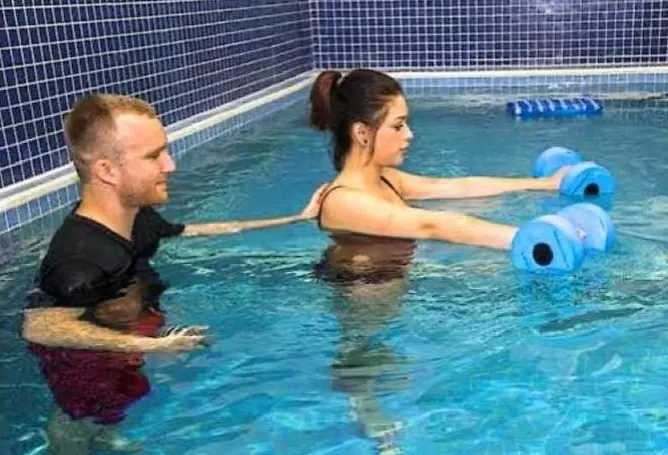
Arm Resistance Movements
- Push and pull the water with arms
- Foam dumbbells or paddles may be used
- Strengthens the upper body and reduces stiffness
Balance Exercises
- Stand on one leg (with support nearby if needed)
- Shift balance from left to right
- The water provides gentle support while challenging stability
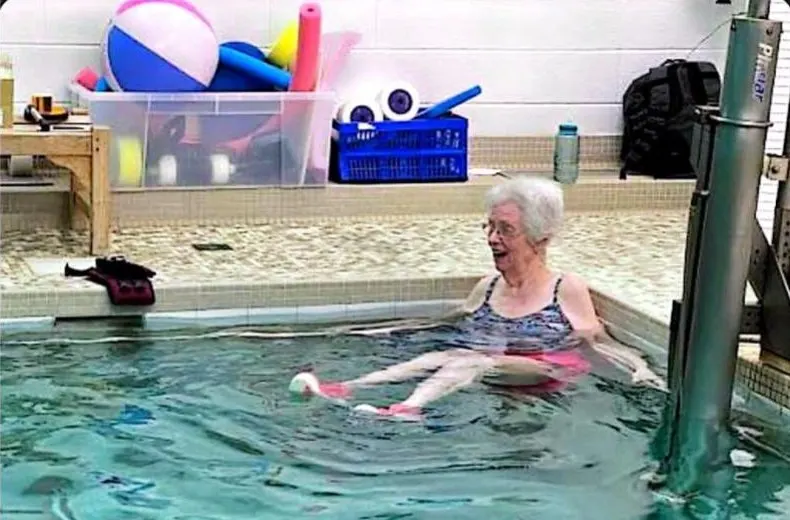
Stretching in Warm Water
- Gentle stretches for arms, legs, neck, and back
- Warm water helps relax muscles and reduce rigidity
Simulated Cycling (in water)
- Hold onto the pool edge and move legs like pedalling
- Great for mobility and rhythm training
Dual-Task Training
- Exercise while performing cognitive tasks (such as counting steps and naming objects)
- Increases cognitive-motor coordination
Safety Tips
- Exercise in supervised settings if possible (physiotherapist or trained instructor)
- Utilise handrails and flotation aids for support
- Do not engage in deep-water exercises without supervision
- Drink plenty of fluids (you might not realize you’re becoming dehydrated due to being in water)
- Be wary of exhaustion (sudden drops in energy may occur with Parkinson’s)
To learn more about how water’s buoyancy, resistance, and warmth contribute to movement recovery, explore the science behind aquatic therapy.
Explore Advanced Aquatic Therapy for Better Movement Recovery
Conclusion
Early rehabilitation and guided exercise therapy can significantly help individuals with Parkinson’s disease maintain mobility and independence. At AquaCentric Therapy, one of the best physiotherapy clinics in Mumbai, advanced programmes focused on neurological rehabilitation in water are designed to support recovery through evidence-based hydrotherapy techniques. They are tailored to improve balance, mobility, coordination, and overall quality of life in Parkinson’s patients. To learn more about specialised Parkinson’s rehabilitation programmes or to begin a guided recovery plan, contact us today.
FAQs
1. What is Parkinson’s disease?
Parkinson’s disease is a progressive neurological disorder that affects movement due to the gradual loss of dopamine-producing neurons in the brain. It can cause symptoms such as tremors, stiffness, slowed movement, and balance difficulties.
2. Is aquatic therapy good for Parkinson’s?
Yes, aquatic therapy is highly beneficial for people with Parkinson’s, as it provides a safe, low-impact environment to improve balance, mobility, flexibility, and coordination. The buoyancy of water also reduces strain on joints and lowers the risk of falls.
3. Is swimming good for someone with Parkinson’s?
Swimming can be beneficial for individuals with Parkinson’s, as it supports cardiovascular fitness, muscle strength, and overall mobility. However, it should be done under supervision if balance or coordination issues are present.
4. How does aquatic therapy help Parkinson’s patients?
Aquatic therapy helps Parkinson’s patients by using water resistance and buoyancy to improve gait, posture, muscle control, and balance. It also promotes safer movement practice and reduces rigidity.
5. Can water exercises reduce Parkinson’s stiffness?
Yes, warm-water exercises can help reduce muscle stiffness and rigidity by relaxing muscles and improving joint mobility. Regular aquatic therapy can also enhance flexibility and ease movement.

Dr. Sakshi Bharadwaj - Physiotherapist
Dr Sakshi Bharadwaj (PT) is a Physiotherapist at AquaCentric specialising in Neurological and Psychosomatic Rehabilitation. She holds a Master of Physiotherapy (MPT) from Chitkara University and is committed to delivering patient-centred, evidence-based care to support recovery and overall well-being. Dr Bharadwaj has completed specialised training in Dry Needling, Spinal Manipulation, and Cupping Therapy, enabling her to provide a comprehensive approach to rehabilitation and pain management. She is also actively involved in academic research and professional development within the field of physiotherapy.
