

Understanding BPPV and Modern Vertigo Rehabilitation
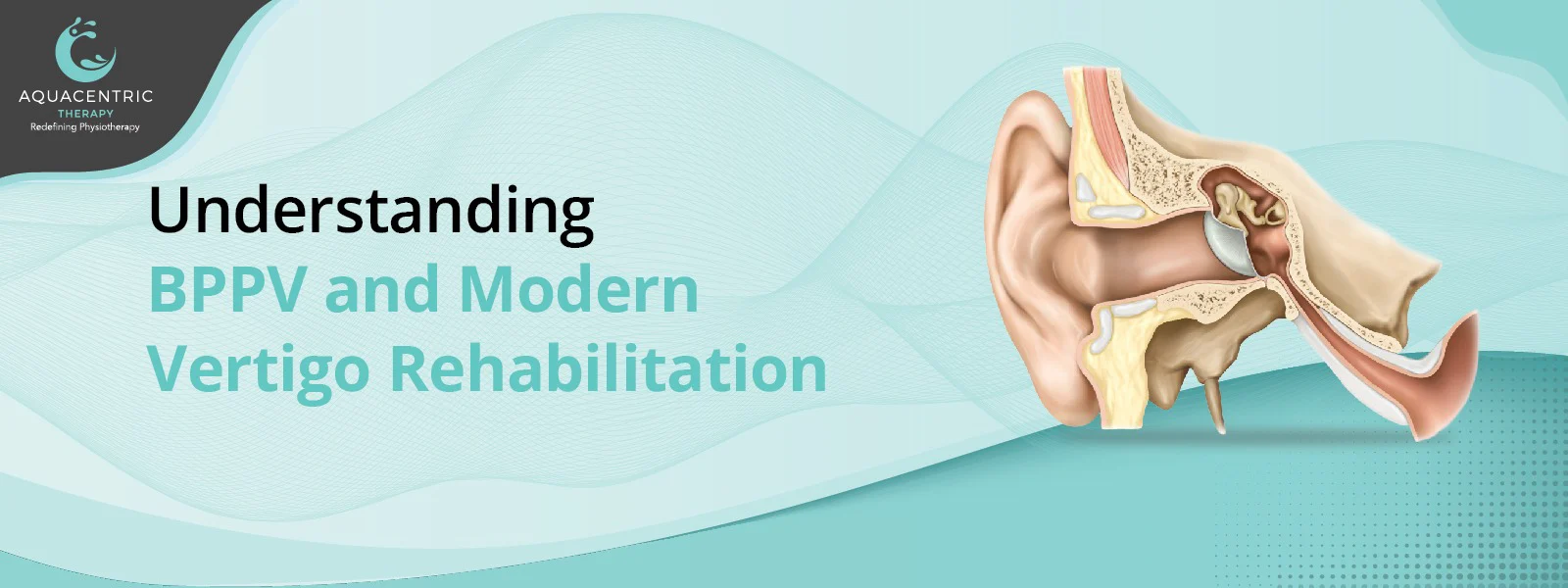
Benign Paroxysmal Positional Vertigo (BPPV) is one of the common inner ear disorders and a leading cause of peripheral vertigo. It can make simple movements such as turning in bed, looking up, or bending down feel suddenly disorienting. Although highly treatable, recurring dizziness and imbalance can affect confidence, mobility, and day-to-day activities.
Today BPPV rehabilitation goes beyond repositioning manoeuvres alone, combining vestibular rehabilitation with structured land-based and aquatic therapy to support recovery more comprehensively. At AquaCentric Clinic, our approach focuses on reducing dizziness, improving balance, restoring movement confidence, and helping patients return safely to their everyday routines.
What Is BPPV?
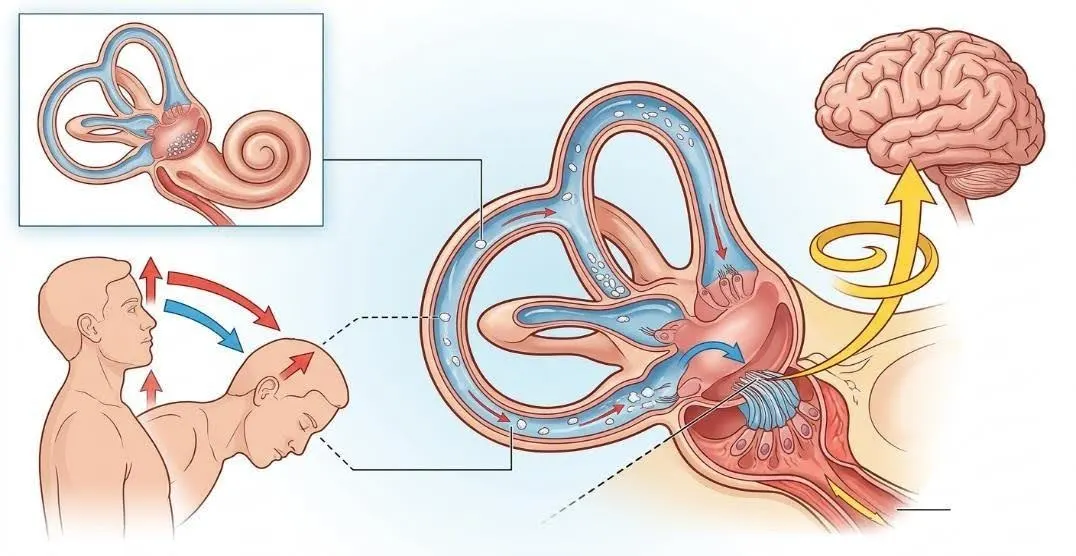
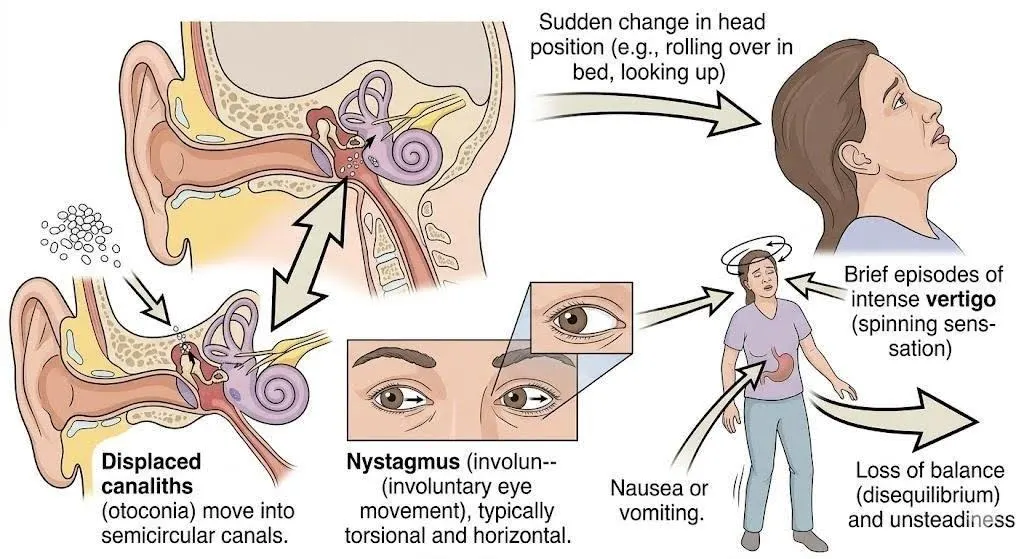
BPPV occurs when tiny calcium carbonate crystals (otoconia), which are normally anchored in the utricle of the inner ear, become displaced and drift into one or more of the semicircular canals. When the head moves in certain directions, like rolling over in bed, looking up, or bending down, these misplaced crystals disturb the normal movement of inner ear fluid, sending incorrect balance signals to the brain and triggering a spinning sensation.
The posterior semicircular canal is most commonly affected, although BPPV can also involve the horizontal or anterior canals, which may produce slightly different patterns of vertigo and involuntary eye movements (nystagmus). Diagnosis is typically made using positional tests, including Dix-Hallpike and roll tests, which help clinicians identify characteristic vertigo symptoms and eye movements linked to BPPV.
Who Is at Higher Risk of BPPV?
While BPPV can affect individuals of any age, its prevalence increases with age, especially after 50–60 years. Several risk factors are supported by current evidence:
- Age-related degeneration of the otolithic membrane in the inner ear.
- Head trauma or concussion, including relatively minor injuries, which may dislodge inner ear crystals.
- Previous episodes of BPPV, as recurrence rates are relatively high over time.
- Vestibular disorders such as vestibular neuritis or Ménière’s disease, which may predispose the inner ear to crystal migration.
- Prolonged bed rest or immobilisation, often seen after surgery or serious illness.
- BPPV is more commonly experienced by women, and conditions like osteoporosis or vitamin D deficiency may also increase the risk, although researchers are still working to better understand the exact mechanism.
What Are the Symptoms and Daily Effects of BPPV?
Specific head movements trigger classic BPPV symptoms, which are usually brief (seconds to 1–2 minutes). Some common symptoms are:
- True vertigo (a spinning or rotational sensation), usually described as “the room is turning.”
- Position-dependent onset, such as rolling over in bed, getting up from lying down, looking up, or tilting the head.
- Nystagmus (rapid, involuntary eye movements) which can be recorded using video Frenzel (specialised video goggles) or observed clinically.
- Nausea or vomiting happens in more severe episodes, while hearing loss and neurological symptoms, such as weakness and speech disturbance, are usually absent.
Besides the sudden spinning episodes, BPPV can also have an influence on balance, confidence, and day-to-day function. Patients experience:
- Balance impairment and unsteadiness, especially in older adults.
- An increased fear of falling, causing patients to limit movement, avoid stairs, or reduce walking.
- Reduced participation in work, exercise, or social activities due to fear of provoking vertigo may lead to physical deconditioning; this is where rehabilitation approaches used in managing chronic pain can also be beneficial.
Even after the underlying crystal displacement has resolved, untreated BPPV can spiral into chronic imbalance and functional disability.
What Does Current Treatment for BPPV Involve?
The international guidelines stress canal-specific repositioning manoeuvres (guided head and body movements used to reposition displaced inner ear crystals) as the primary treatment for BPPV. For posterior canal BPPV (the most common type), the Epley manoeuvre is the most widely used and evidence-supported technique. For horizontal canal involvement, the Barbecue (or Gufoni) manoeuvre is generally used.
Research indicates:
- In many cases, a single session of an appropriate manoeuvre can reduce or resolve symptoms to a great extent, while it also depends on canal involvement and individual factors.
- Repeating manoeuvres during the same session or over subsequent visits further improves treatment outcomes.
- Vestibular rehabilitation (VRT) can help in improving balance, gait, and overall function, especially in older adults and those with persistent imbalance after BPPV, similar to the multidisciplinary care approaches used in a neurorehabilitation centre in Mumbai.
Systematic reviews and clinical studies also suggest that canal repositioning and vestibular rehabilitation work well together.
- CRP (canal repositioning procedure) rapidly removes the offending crystals.
- VRT improves the way you hold your gaze steady, balance better, and get used to movements. The best part is that it reduces fall risk.
Start Your Vertigo Recovery Journey
How Does Land-Based Vestibular Rehabilitation Help BPPV?
Land-based vestibular rehabilitation is an individually prescribed, exercise-based programme that aims to decrease vertigo, enhance gaze stability, and restore balance and confidence in movement. After successful canal repositioning, we tailor the land-based programme at AquaCentric Clinic to each patient’s age, other health conditions, and functional goals.
Below are the main elements of land-based rehab:
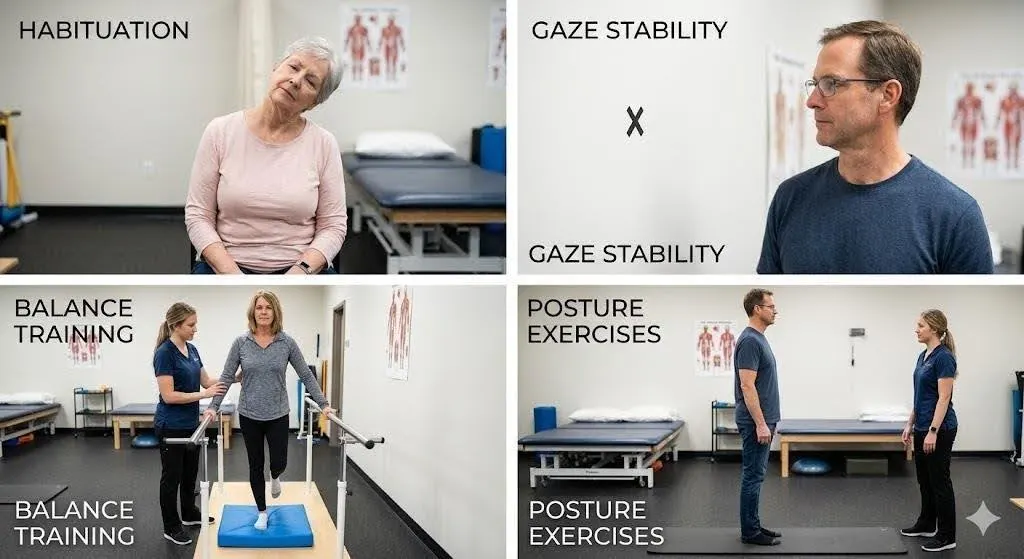
1. Gaze Stabilisation Exercises
Such exercises train the vestibulo-ocular reflex (VOR), which helps keep vision steady during head movements. Some common drills are below:
- VOR x1: Keeping the eyes fixed on a target while the head moves slowly side to side or up and down.
- VOR x2: Maintaining focus on a moving target while the head also moves.
Patients usually start at a low speed and with small movements, gradually increasing difficulty as symptoms improve.
2. Habituation Training
Habituation exercises lead to mild, controlled dizziness to desensitise the vestibular system. Some of the examples include:
- Repeated head movements or controlled spinning in a chair.
- Walking with head turns or on uneven surfaces.
The goal is to help the brain gradually adapt to movement and balance changes without causing severe vertigo, ideally within a 1–3 out of 10 discomfort scale.
3. Static and Dynamic Balance Training
Data show that VRT improves static stance and dynamic mobility, mostly in older adults. Common activities are:
- Standing in progressively challenging conditions (narrow base, unstable surfaces, eyes closed).
- Walking with head turns, stepping over obstacles, and turning while walking to improve coordination and balance during daily activities.
- For monitoring progress using functional tests like the Dynamic Gait Index (DGI) and Berg Balance Scale.
4. Education and Home Exercise Programmes
Structured home exercises are vital for success in the long term. Our physiotherapists teach patients safe self-repositioning techniques (for e.g., modified home Epley) and progressive balance drills, ensuring consistency and adherence between sessions.
Overall, land-based VRT improves static and dynamic balance, enhances functional gait, and reduces fall-related fear, even if it does not always prevent recurrence of BPPV itself.
How Can Aquatic Therapy Help BPPV Recovery?
Aquatic (hydrotherapy) vestibular rehabilitation is increasingly being used in addition to traditional land-based therapy. It is generally used for patients with joint pain, a high fall risk, or a major fear of movement on land. The unique properties of water make it an ideal environment for safely retraining balance and vestibular function after BPPV through several biomechanical advantages:
- Buoyancy lowers effective body weight by up to 80–90%, offloading joints and decreasing the severity of falls while allowing more challenging exercises.
- Hydrostatic pressure improves circulation and provides gentle sensory feedback that improves body awareness and balance control.
- Water resistance works in multiple directions, helping activate postural and core muscles without high impact.
For patients with chronic vestibular dysfunction, aquatic therapy has been shown to help dizziness, improve balance and postural control, and even increase subjective confidence in movement.
Aquatic VRT for BPPV
At AquaCentric Clinic, our aquatic BPPV programme follows a structured and graded approach:
1. Initial stabilisation phase
-
- Gentle walking in water, advancing from shallow to deeper areas.
- Weight shifting and small whole-body movements to stimulate vestibular input without causing severe vertigo.
2. Gaze and postural control training
- Patients maintain fixation on a stable target on the pool wall while performing controlled head movements (pitch, yaw, roll).
- Simple standing and marching drills with head turns, supported by handrails initially or therapist contact and gradually reduced as stability improves.
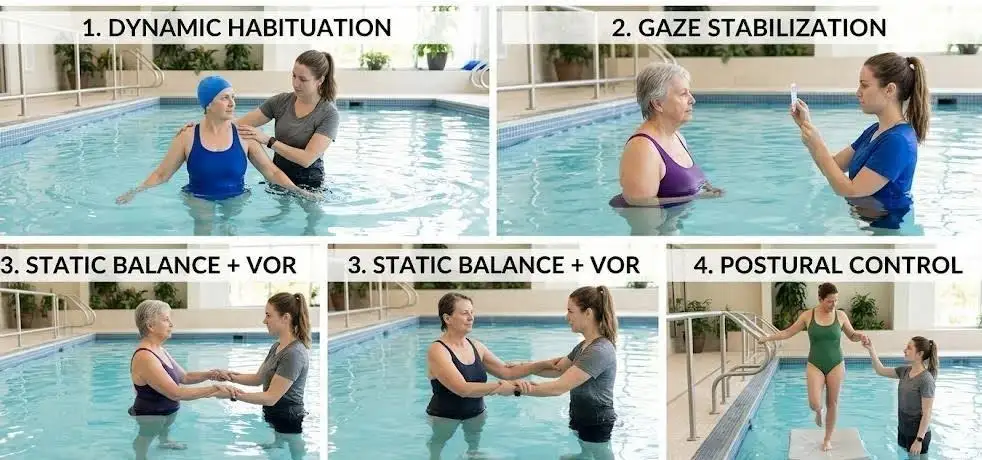
3. Dynamic balance and fall recovery drills
- Walking with therapist-induced gentle pushes or pulls in water, replicating destabilising forces.
- Turning, side-stepping, and backwards walking in chest-deep water to challenge balance in a safer environment.
4. Functional integration
- Demonstration of activities of daily living (reaching, bending, and walking up and down stairs) in water simulates these activities to prepare for safe return to land-based activities.
Studies show that aquatic physiotherapy for vestibular rehabilitation can help patients with balance performance, dizziness-related limitations and build confidence in movement after about 10 sessions. These benefits are valuable in patients with chronic or persistent imbalance following BPPV, where fear of movement limits progress on land.
Integrating Land and Aqua Rehab at AquaCentric Clinic
At AquaCentric Clinic, our BPPV rehabilitation pathway is created to progress in stages which, if needed, allows overlap between therapies:
Phase 1: Initial Management
- Detailed vestibular assessment and canal-specific repositioning manoeuvres (Epley, Barbecue, etc.) performed by a trained vestibular physiotherapist.
- Brief education on positional triggers and home safety modifications.
Phase 2: Early Vestibular Rehabilitation (land)
- Gentle gaze stabilisation and habituation exercises, gradually increasing complexity.
- Basic static balance and gait training tailored to the patient’s age as well as risk profile.
Phase 3: Aquatic Transition (if indicated)
- Patients which have high fall risk, joint pain, or significant fear of movement progress to the aquatic programme.
- Aquatic VRT helps with balance, control, and vestibular recovery in a safe, low-impact environment.
Phase 4: Advanced Land-based and Functional Reintegration
- This stage focuses on complex dynamic balance tasks, community-based gait training, and activity- or sport-specific training.
- Ongoing monitoring of recurrence risk and reinforcement of home exercise adherence.
The integrated approach is supported by recent evidence showing better recovery outcomes when canal repositioning and vestibular rehabilitation are combined, mainly in older adults and the patients who continue to experience ongoing imbalance.
Get Expert Help for BPPV and Balance Issues
Conclusion
BPPV is a common but highly manageable cause of vertigo, recovery in today’s times goes beyond repositioning manoeuvres only. Integrating canal-specific treatment with land-based and aquatic vestibular rehabilitation can help in improving balance, reducing dizziness, rebuilding confidence in movement, and supporting smoother recovery in the long term. At AquaCentric Therapy, one of the best physiotherapy clinics in Mumbai, we provide expert support for vertigo and balance rehabilitation through evidence‑based BPPV rehabilitation programmes tailored to each patient’s functional needs and recovery goals.
If you are seeking personalised, clinically tested care, contact us to discuss how our BPPV rehabilitation programmes can support your recovery.
FAQs
1. What is aquatic therapy for vertigo?
Aquatic therapy for vertigo is a form of vestibular rehabilitation performed in water to improve balance, coordination, and movement confidence. The supportive properties of water create a safer, low-impact environment for balance retraining.
2. How does water therapy improve balance after BPPV?
Water therapy helps improve balance after BPPV by allowing patients to practise head movements and postural control exercises with reduced fear of falling. Buoyancy and water resistance also provide gentle sensory feedback that supports balance recovery.
3. Is aquatic therapy better than land-based therapy for vertigo recovery?
Aquatic therapy is not a replacement for land-based vestibular rehabilitation, but it can be beneficial for patients with significant imbalance, joint pain, or fear of movement. Combining both approaches often supports more effective recovery.
4. How does aquatic rehabilitation support recovery from dizziness and imbalance?
Aquatic rehabilitation supports recovery by improving postural control, gait stability, balance adaptation, and movement confidence through structured low-impact exercises. It may also help reduce dizziness-related anxiety and fall risk.
5. Is aquatic vestibular rehabilitation safe for older adults?
Yes, aquatic vestibular rehabilitation is generally safe for older adults when supervised by trained physiotherapists. The buoyancy of water reduces joint stress and fall risk, making exercises safer and more comfortable. Connect with us to learn more about our personalised vestibular rehabilitation programmes.

Dr. Yash Shaha - Physiotherapist
Dr Yash Shaha (PT) is a Physiotherapist at AquaCentric specialising in Neurological Rehabilitation. He holds a Master of Physiotherapy (MPT) from Rajiv Gandhi University of Health Sciences and is dedicated to helping individuals improve function, mobility, and quality of life through evidence-based care. Dr Shaha has received specialised training in Dry Needling, COMT, and Taping techniques and has contributed to physiotherapy research, earning recognition for his publication on post-stroke upper limb rehabilitation and neurorehabilitation interventions.
