

Aquatic Physiotherapy for Post-Surgical Clubfoot Recovery: Breaking Through the Functional Plateau — A Pediatric Case Report
INTRODUCTION
Clubfoot (Congenital Talipes Equinovarus / CTEV) affects 1–2 per 1,000 newborns. Most cases respond to the Ponseti method, but complex or recurring deformities often require surgery, which corrects the structural problem, but does not always restore full function.
Many children plateau at roughly 90% recovery, compensating with trunk sway, knee hyperextension, or in-toeing. Gravity continuously reinforces these patterns, and conventional land-based therapy frequently cannot resolve them.
Aquatic therapy offers a different environment: buoyancy offloads joint stress; hydrostatic pressure reduces residual swelling; and water’s viscosity provides proportional, multidirectional resistance.
PATIENT PROFILE
A 10-year-old boy with bilateral CTEV underwent right-sided Achilles tenotomy and bilateral hindfoot correction at two months of age, followed by the full Ponsetti protocol. Even 10 years later, he presented with bilateral ankle stiffness and reduced lower limb power. He could run, jump, and manage all age-appropriate gross motor tasks, but while compensating with excessive trunk sway, lumbar hyperlordosis, and knee hyperextension. The goal of our aquatic intervention was to correct these compensations and recover the function that conventional therapy had not been able to achieve.
INITIAL ASSESSMENT: FINDINGS
Baseline assessment revealed lower limb muscle power of MRC Grade (3-)/5, i.e. most, not full, of the movement possible against gravity. The foot intrinsic muscles were nearly inactive, overpowered by the tight dominant calf muscles.
Table 1 summarises the full impairment profile.
Table 1: Baseline Assessment Findings
Pre-intervention profile
| Category | Findings at baseline |
| Tightness | Bilateral gastrocsoleus, hamstrings, quadriceps, ITB, piriformis (right > left) |
| Muscle strength | MRC Grade (3-)/5;
Notably foot intrinsics and core |
| Range of motion (ROM) | Right ankle ROM reduced at baseline;
bilateral hip flexor ROM reduced |
| Postural deviations | Increased lumbar lordosis; right knee hyperextension;
slight genu varum; right foot mild inversion |
| Pediatric Bergs Balance Scale | Total score: 40 / 56
|
MRC = Medical Research Council scale; ITB = Iliotibial Band; ROM = Range of Motion; P-BBS = Pediatric Bergs Balance Scale
INTERVENTION
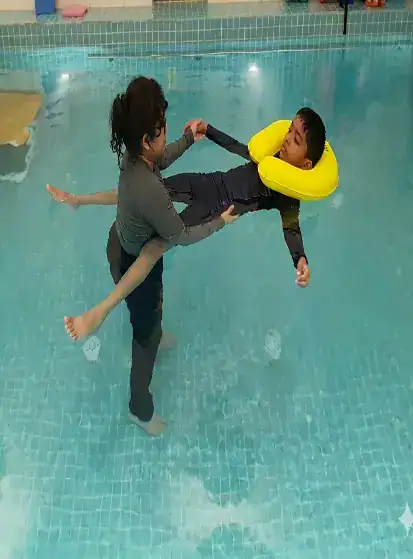
30 aquatic sessions were delivered 3 times a week over 12 weeks. The intervention was structured across three overlapping phases, each targeting a distinct layer of the child’s impairment.
| Phase 1: Soft Tissue Release | Phase 2: Neuromuscular Facilitation through The Bad Ragaz Ring Method (BRRM) | Phase 3: Balance and Postural Re-integration |
| Water-based myofascial techniques were applied to the posterior and medial kinetic chains to address chronic tightness and fascial restrictions. This phase targeted tissues difficult to access through conventional manual therapy, preparing the neuromuscular system for active loading in subsequent phases. This was combined with ‘water specific therapy’ and ‘passive therapy’ for increasing flexibility. | Resistance-based, coordinated, and diagonal aquatic movement patterns were used to activate and progressively load the weak muscle groups. The aquatic environment allowed the child to recruit and train the core and lower limb stabilizers in isolation without triggering the habitual compensatory strategies that masked true weakness on land. | Through Water Specific Therapy, buoyancy-based stability challenges progressively loaded the deep core and foot stabilizers in both reactive and proactive contexts. Progressively challenging rotational control tasks leveraged the inherent instability of the aquatic medium to bypass entrenched postural habits and engage the stabilizing systems at a neurological level. Aquatic props were introduced progressively to increase demand. |
RESULTS
The most significant improvements appeared in balance: the metric most sensitive to neuromuscular integration. On the pediatric Berg Balance Scale (PBBS), the child had moved up 14 points by week 12, toward independent function. Tasks such as single-leg stance and tandem standing which were previously difficult showed improvement, reflecting both improved ankle mobility and the newly recruited foot and core stabilizers.
Table 2: Post-Intervention Results: Strength, ROM and functional outcomes after 12 weeks
| Category | Baseline | After 12 weeks | Outcome |
|
Tightness |
Bilateral gastrocsoleus, hamstrings, quadriceps, ITB, piriformis (right > left) | Reduced bilateral tightness;
piriformis and gastrocsoleus notably improved |
Improved soft-tissue extensibility |
| Muscle strength | (3—)/5 (MRC);
foot intrinsics and core weak |
(4—)/5 (MRC);
core and foot intrinsic strength improved |
Significant gain in muscle strength |
| Range of motion (ROM) | Reduced right ankle ROM | Increased 4° right ankle dorsiflexion | 3° deficit vs left;
functionally resolved |
| Postural deviation | Increased lumbar lordosis;
right knee hyperextension; slight genu varum; right foot mild inversion |
Lumbar lordosis reduced;
right knee hyperextension resolved; right foot neutral |
Improved pelvic alignment;
normalised lower limb mechanics; structural normalisation of foot achieved |
| Pediatric Bergs Balance Scale | Total: 40 / 56
|
Total: 54 / 56
|
Significant improvement in balance;
right-left asymmetry reduced; marked gain in dynamic stability |
MRC = Medical Research Council scale; ITB = Iliotibial Band; ROM = Range of Motion; P-BBS = Pediatric Bergs Balance Scale
DISCUSSION
Neuromuscular decoupling explains these results. On land, the child linked ankle movement with knee hyperextension as a survival strategy, compromising normal mechanics. In water, both movements were trained separately, helping the brain unlearn this pattern. Improvement was neurological, not just muscular. Buoyancy-based rotations reduced pelvic tilt and activated deep spinal stabilisers. A 3° ankle ROM deficit remains, likely structural but not functionally limiting.
CONCLUSION
This case confirms that aquatic physiotherapy can resolve functional plateaus in post-surgical CTEV that conventional rehabilitation cannot. Water’s unique physical properties make it a precise neurological tool, not merely a low-impact exercise medium. After 30 . Sessions, the child progressed from years of compensatory movement to confident, unrestricted participation in daily activities. A hybrid land-aquatic program is recommended to consolidate and transfer these gains into everyday life.

Dr. Medha Janjani (PT)
Dr. Medha Janjani is a Physiotherapist at AquaCentric, specialising in neurological rehabilitation for paediatric and adult patients. She holds a Master of Physiotherapy (MPT) in Neurological Conditions and is an IATF-certified Aquatic Therapist (WST, BRRM). Dr. Janjani has experience in the assessment and rehabilitation of neurological conditions using evidence-based physiotherapy and aquatic therapy.
