

Healing in Water: How Aquatic Therapy Transforms Life with Ankylosing Spondylitis
Living with a stiff, aching spine that greets you every morning can feel deeply isolating. For those affected by Ankylosing Spondylitis (AS), Movement — the very thing that hurts is also the most powerful medicine. And when that movement happens in warm water, the results can be truly remarkable.
What Is Ankylosing Spondylitis?
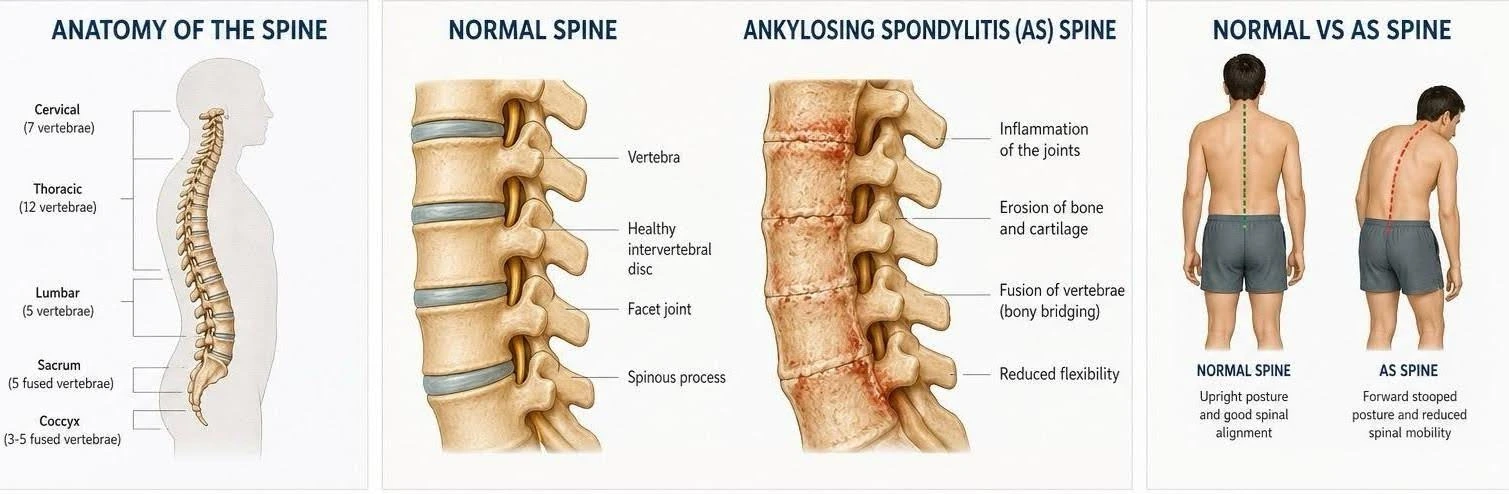
Ankylosing Spondylitis is a chronic inflammatory arthritis that primarily targets the axial skeleton — the spine and the sacroiliac joints where the lower back meets the pelvis. Unlike wear-and-tear arthritis, AS is driven by an overactive immune system that attacks the body’s own tissues, triggering persistent inflammation in and around the spinal joints.
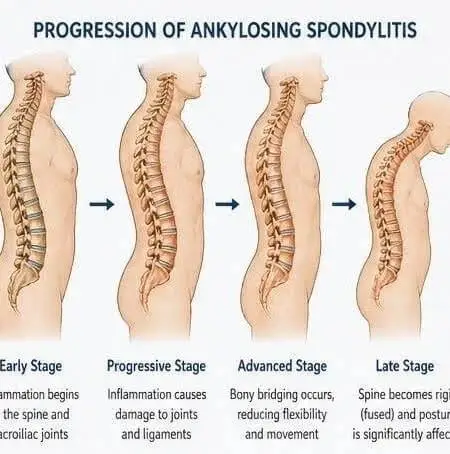
Over time, this inflammation stimulates new bone formation between vertebrae, gradually fusing them together. In severe cases, this leads to what is sometimes called “bamboo spine”, a rigid, immovable column that forces the body into a hunched, forward-bent posture. The consequences extend beyond the spine: AS can inflame the eyes (anterior uveitis), the gut (inflammatory bowel disease), and the skin (psoriasis). When rib cage joints stiffen, even breathing becomes difficult, and the risk of spinal fractures more than doubles compared to the general population.
One of the most distinctive features of AS is its pattern of pain. Unlike a herniated disc that worsens with movement, AS stiffness is worst after rest particularly in the early morning and actually improves with activity. This paradox is a hallmark of inflammatory back pain and is often the first clue that leads to diagnosis.
Who Is More Prone to AS?
AS is not a disease of old age. It typically strikes young adults in their prime, with roughly 80% of patients first experiencing symptoms before age 30. It is rare for the condition to appear after 45. Globally, AS affects an estimated 0.1–1% of the population, making it far more common than many realize.
For decades, AS was considered predominantly a male disease, with men thought to be two to three times more likely to develop it. Recent research, however, has challenged this assumption. Women with AS are frequently under diagnosed or face significant delays because their symptoms often present differently, more peripheral joint pain and fatigue rather than the dramatic spinal changes visible on imaging.
Genetics plays a central role. The HLA-B27 gene is found in the vast majority of AS patients, and having a first-degree relative with the disease substantially increases one’s own risk. AS prevalence tracks closely with the geographical distribution of HLA-B27 highest among Northern European populations and lowest in sub-Saharan Africa and Japan.
Rehabilitation on Land
Every major rheumatology body from EULAR and ASAS to the American College of Rheumatology agrees: exercise is the single most important non-drug intervention for AS. While medications manage inflammation at a molecular level, exercise addresses the functional consequences stiffness, weakness, postural changes, and fatigue.
An effective land-based program typically combines three pillars. First, cardiovascular training to build endurance and combat the deep fatigue AS patients frequently experience. Second, resistance exercises targeting the core, back extensors, and hip muscles that support and stabilize the spine. Third, flexibility and stretching routines focused on maintaining range of motion in the spine, hips, and rib cage.
The evidence is substantial. Systematic reviews of multiple randomized controlled trials involving nearly 1,600 participants have confirmed that structured exercise programs produce meaningful improvements in physical function, pain, and disease activity scores. Even simple home-based routines, performed five times a week for 30 minutes deliver significant gains in pain, spinal flexibility, respiratory function, and quality of life.
Land-based exercise also offers critical long-term benefits beyond symptom management. Regular weight-bearing activity maintains bone density particularly important given that AS patients face elevated fracture risk. Consistent exercise also reduces anxiety, depression, and the social withdrawal that so often accompanies chronic pain.
Rehabilitation in Water: The Game-Changer
For many AS patients, however, the road to regular land-based exercise is paved with pain. Stiff, inflamed joints resist movement, and fear of triggering a flare becomes a powerful barrier. This is precisely where aquatic therapy transforms the equation.
Aquatic therapy delivers evidence-based exercise principles in a warm-water environment, typically maintained between 32–33°C. The physical properties of water — buoyancy, hydrostatic pressure, and viscous resistance create a uniquely forgiving yet effective therapeutic setting.
- Joint offloading:
- Natural pain relief:
- Graded resistance:
- Cardiovascular support:
Buoyancy supports 60–80% of body weight at chest-level immersion, dramatically reducing mechanical load on inflamed joints. Movements that are painful or impossible on land become achievable, even comfortable in water.
Warm water stimulates thermal and mechano-receptors, dampening pain signals and relaxing muscle spasms. This analgesic effect allows patients to exercise through a greater range of motion than they could tolerate on dry ground.
Unlike gym machines that work muscles along fixed planes, water resists movement in every direction. Patients fine-tune intensity by adjusting their speed or limb position, no heavy weights, no jarring forces.
Hydrostatic pressure gently compresses the body, assisting venous return, reducing swelling, and supporting heart and lung conditioning.
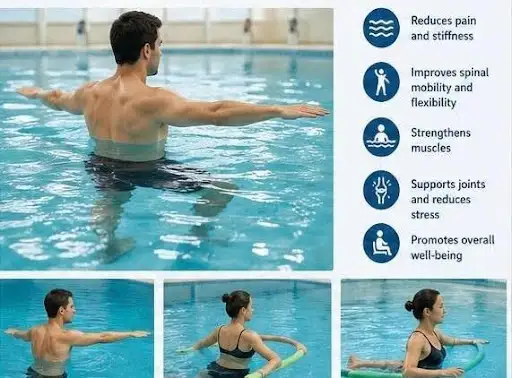
Clinical trials have consistently validated these benefits. Studies comparing pool-based exercise programs with home-based routines in AS patients have found that the aquatic groups achieve significantly greater improvements in pain reduction, general health, vitality, social functioning, and emotional well-being. Meta-analyses encompassing over 1,300 participants have confirmed statistically significant reductions in both pain and disease activity scores among those receiving aquatic therapy. Systematic reviews have further concluded that water-based exercise is an excellent alternative for patients who cannot tolerate land-based routines offering comparable or superior outcomes with far less discomfort during sessions.
Perhaps equally important are the psychological benefits. Research consistently reports that AS patients who exercise in water experience improvements in mood, social confidence, and emotional resilience, outcomes that are difficult to achieve when every step on land is a reminder of the disease. The warm, supportive environment of a therapy pool often becomes one of the few places where patients feel truly free to move without fear.
Combining Both Worlds: The Ideal Approach
The strongest evidence now points to a combined approach. Aquatic and land-based therapies are not competitors, they are complementary partners in managing AS.
Water sessions excel at pain management, relaxation, and gentle mobility work, particularly in the early stages of rehabilitation or during disease flares. Land-based training offers superior opportunities for load- bearing strengthening, functional balance work, and the bone-density benefits that come with exercising against gravity.
The practical advice from current clinical guidelines is straightforward: start in the water to build confidence, reduce pain, and restore basic mobility. As strength and tolerance improve, gradually introduce land-based exercises to consolidate gains and build functional independence. During flare-ups, the pool becomes a refuge a place where movement remains possible even when the disease is at its most aggressive.
For the millions living with Ankylosing Spondylitis, this dual approach offers something profoundly valuable: not just less pain, but more life.

Dr. Charmi Sheth - Senior Physiotherapist
Dr Charmi Sheth (PT) is a Senior Physiotherapist at AquaCentric specialising in Musculoskeletal (MSK) and Sports Rehabilitation. She holds a Master of Physiotherapy (MPT) from Cardiff Metropolitan University, United Kingdom, and brings over 7 years of clinical experience in injury rehabilitation, pain management, and performance optimisation. Dr Sheth has completed specialised training in Needling, Cupping, and Taping techniques, allowing her to provide comprehensive, evidence-based physiotherapy care. Her expertise focuses on helping individuals recover effectively, restore function, and achieve their rehabilitation goals.
