

Meniscal Tears Explained: Causes, Healing Factors, and Pool Exercises for Knee Rehab
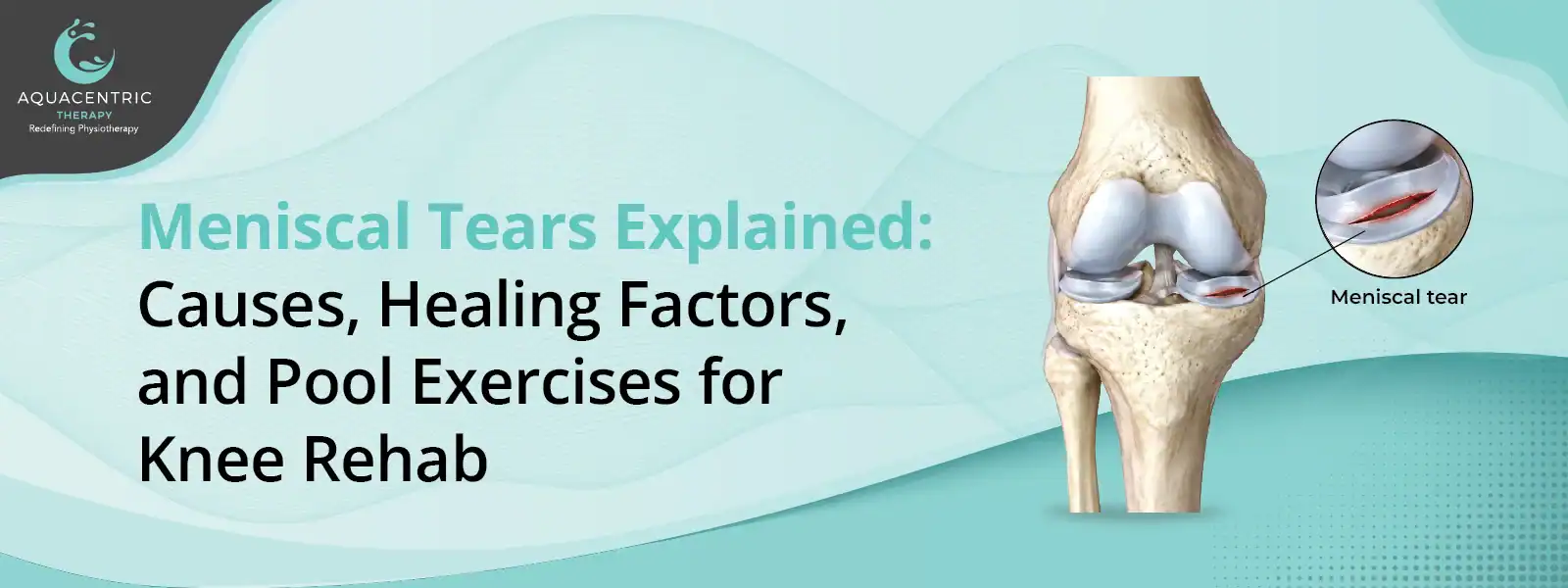
The standard approach to treating meniscus tears is failing too many patients. While this injury is exceptionally common across all age groups, a lack of precise rehabilitation often turns a straightforward recovery into a cycle of chronic pain.
At our physiotherapy centre in Mumbai, we approach knee rehabilitation through the lens of advanced biomechanics. Our team has pioneered protocols that utilise the unique properties of hydrotherapy exercises alongside elite land-based physical therapy.
This article will walk you through the factors affecting meniscal healing. We will also discuss the rehabilitation strategies for a safer recovery.
Overview of Meniscal Injuries: Anatomy and Function
The menisci are two wedge-shaped pieces of fibrocartilage that act as a shock-absorption system for your knee joint. They play a critical role in maintaining long-term joint health and protecting your articular cartilage by increasing the contact area between your femur (thigh bone) and tibia (shin bone). This distribution of surface area is what allows your knee to disperse impact efficiently and reduces overall joint stress.
When the meniscus is removed, particularly in a total meniscectomy, significant biomechanical changes occur:
- Contact area decreases by approximately 50%.
- Shock absorption is reduced by around 20%.
- Load transmission is severely altered, as the menisci transmit around 50% of body weight when the knee is straight and up to 85% when bent to 90°.
Normally, healthy menisci protect the centre of the knee joint by shifting pressure to the stronger outer edges, which optimises stability and weight distribution.
Why Certain Areas Tear More Than Others
The natural mobility of each meniscus varies, directly affecting its risk of tearing:
- The lateral meniscus is more mobile than the medial one. This helps the outer meniscus slide safely away from joint pressure.
- The anterior horn moves more than the posterior horn. This helps the front sections of the cartilage glide much more freely than the back.
- The posterior horn of the medial meniscus is particularly vulnerable due to its significantly reduced mobility and increased stress during movement. This makes it one of the most common sites for meniscal tears.
Types of Meniscal Tears
Meniscal tears come in many shapes and sizes. They are usually classified by their pattern or root cause:
- Longitudinal / Bucket-Handle: Vertical tears running parallel to the long axis of the meniscus.
- Horizontal: Tears that slice the meniscus into top and bottom halves.
- Oblique / Flap: Diagonal tears that can create a loose flap of tissue.
- Radial: Horizontal tears that cut from the inner rim outward; highly disruptive to load distribution.
- Traumatic: Sudden tears resulting from forceful twisting, usually observed in athletes.
- Degenerative: Arising over time due to age. These tears occur alongside broader joint degeneration.
If this sounds familiar, our guide on water therapy for knee arthritis may also be relevant to your recovery.
Factors Influencing Meniscal Healing
The Delicate Balance of Movement and Weight-Bearing
- Controlled Weight-Bearing: Compression helps heal longitudinal tears by pressing tissue edges together. But it can worsen radial tears by forcing them apart.
- Avoid Long Immobilisation: Keeping the knee locked straight causes meniscal atrophy and depletes collagen, permanently weakening the joint structure.
- ROM Boundaries: Keeping flexion under 60° minimises stress. Moving beyond 60° shifts the posterior horn backwards, sharply increasing compressive loads.
Clinical Takeaway: A balanced protocol combining early, protected weight-bearing with restricted flexion is essential to safeguard healing tissues.
Your Leg Alignment (Bow-Legged vs. Knock-Kneed)
Natural leg alignment dictates weight distribution across the knee joint:
- Varus (Bow Legs): Shifts the weight inwards, increasing stress on the medial compartment and meniscus.
- Valgus (Knock Knees): Shifts force outwards, stressing the lateral compartment and meniscus.
Mal-alignment delays tissue repair. Utilising an unloader brace temporarily redirects this compartmental stress, supporting a safer recovery.
How Meniscal Tears Are Treated
- Partial Meniscectomy
During this quick procedure, the surgeon trims away the frayed, unstable pieces of the tear. The goal is to restore the full range of motion and wake up your quadriceps muscles. - Meniscal Repair
The torn tissue is carefully stitched back together. Rehab is slow and conservative, especially for high-risk tears. Strict precautions limit weight-bearing and restrict knee flexion to ≤60° for four weeks.
Maintain your conditioning while your knee heals with our specialised pool exercises for athletes
Dual-Pathway Rehabilitation: Aquatic and Land-Based Approaches.
To safely achieve optimal outcomes without overloading a healing meniscus, modern physical therapy utilises a dual-pathway approach: aquatic therapy and land-based exercise.
Aquatic Therapy Exercises
| Exercise | Description | Clinical Goal | Key Benefit |
| Water Walking | Walking forward/backwards in chest-deep pool water | Gait retraining | Reduced joint load due to buoyancy |
| Marching in Water | Alternating knee lifts | Improve controlled knee flexion | Safe ROM progression |
| Straight Leg Kicks | Forward kicks while standing | Quadriceps activation | Low-impact strengthening |
| Side-stepping | Lateral walking in water | Hip & knee stability | Multi-plane control |
| Mini Squats (Water) | Partial squats (30–45°) | Functional strengthening | Reduced compressive forces |
| Heel Raises | Rising onto toes | Calf strengthening | Improved circulation & balance |
Land-Based Exercises
| Exercise | Description | Clinical Goal | Key Benefit |
| Quad Sets | Isometric contraction of the quadriceps | Muscle activation | Early-stage strengthening |
| Straight Leg Raise | Lift the leg while keeping the knee straight | Quadriceps control | No knee movement required |
| Heel Slides | Sliding the heel towards the body | Improve knee flexion ROM | Gentle mobility restoration |
| Mini Squats (Land) | Controlled squats (≤45°) | Functional strength | Weight-bearing adaptation |
| Step-Ups | Step onto the low platform | Functional movement training | Improves daily activity tolerance |
| Terminal Knee Extension | Band-assisted knee extension | End-range control | Strengthens the locking mechanism |
Clinical Comparison: Which is the Best One?
| Feature | Aquatic Therapy | Land-Based Therapy |
| Joint Load | Very low (buoyancy-assisted) | Full/partial weight-bearing |
| Pain Tolerance | Higher (less pain during movement) | May be limited initially |
| Strength Gains | Moderate (water resistance) | High (progressive loading) |
| Functional Carryover | Moderate | High |
| Best Phase | Early to mid rehab | Mid to late rehab |
Emerging Evidence in Rehabilitation
Recent research highlights the effectiveness of both aquatic and land-based exercises for knee pain.
A 2023 study on aquatic rehabilitation demonstrated:
- Significant pain reduction after 8 weeks
- Improved daily functional activities
- Enhanced knee flexion range
- Increased flexor and extensor muscle strength
Another 2023 randomised controlled trial comparing aquatic exercise and land-based exercise following arthroscopic partial meniscectomy found:
- Both approaches significantly improved pain, function, muscle strength, and quality of life
- No clear superiority between methods
These findings support the inclusion of either approach in rehabilitation programmes, depending on patient needs, preferences, and clinical context.
Ready to start healing without the heavy joint stress? Check out our step-by-step water therapy exercises for knee injuries
Conclusion
True meniscus rehabilitation requires a dynamic strategy that shields the joint from harmful stress while strategically building the strength needed for long-term stability. At AquaCentric, we provide advanced knee and meniscus rehabilitation exercises to deliver this exact balance of protection and progression.
If you want clarity on the most effective recovery plan for your specific injury, our specialist physiotherapy team is available to assist you. Contact us today to begin your journey back to peak performance and everyday comfort.
FAQs
1. Is aquatic therapy good for meniscus injuries?
Yes. Water buoyancy supports up to 90% of your body weight. This dramatically reduces the stress placed on your healing meniscus. It allows you to safely practice walking, bending, and early strength training without overloading the joint.
2. How long does meniscus rehabilitation take?
- Non-surgical recovery: Typically takes 6 to 12 weeks, focusing on progressive strengthening and swelling control.
- Post-surgical recovery: Can take 3 to 6 months, depending on the procedure. Simple clean-ups (meniscectomy) heal faster, while full meniscus repairs require a much slower timeline to protect the stitches.
3. Can hydrotherapy reduce knee pain after a meniscus injury?
Yes. Hydrotherapy reduces pain in two major ways. First, hydrostatic pressure (the natural pressure of water against your body) acts like a compression stocking to pump away joint swelling. Second, warm water relaxes guarding muscles and blocks pain signals, making movement much more comfortable.
4. When should aquatic therapy start after meniscus surgery?
Aquatic therapy can typically begin around 2 to 3 weeks post-surgery, but only after your surgical incisions are completely closed, dry, and free of stitches. This is to prevent infection.
5. Is aquatic physiotherapy effective for sports-related knee injuries?
Highly effective. It bridges the gap between early-stage healing and a high-performance return to sport. Athletes can maintain cardiovascular fitness, practise running mechanics in deep water, and train explosive movements like jumping with significantly less impact on the joints.

